Science and technology news from Hopkinton Independent School

Sunday, June 8, 2008

the lymphatic system


the lymphatic system has many jobs. first it serves as a defense mechanisms because it filters out organisms that cause disease. It also produces certain white blood cells and generates antibodies. the lymphatic system distributs fluids and nutrients in the body. it also drains excess fluids and protein so that tissues do not swell up. here is a picture of the lymphatic system

Saturday, May 24, 2008

Skeletal System (by Michael Collins)


There are 27 bones in each hand, with 8 in the wrist, 5 in the palm, and 14 in the fingers and the thumb. There are three bones in each finger, and 2 in the thumb. The distal phalanx, middle and the proximal phalanx are the bones that make up the fingers, although the thumb does not have a middle phalanx. While typing this, I believe I used all my finger-bones, although I might not have used my metacarpals, which are the bones that connect your fingers to your wrist.
-- Michael Collins

Thursday, May 22, 2008

Urinary System

      Your body makes chemical waste items that it can not use.  Then it goes to the bloodstream to then go to the kidneys. Then the kidneys sepraet the waste from the stuff your body needs. when your bladder becames too full sends a message to your brain. you feel the need to pee and start looking for a place to pee.  


http://yucky.discovery.com/flash/body/pg00012.html

Wednesday, May 21, 2008

the SPLEEN

one of the most made fun of body parts in a human body, but it is the biggest of the lymphoid tissues is the spleen. It is just about the size of the heart and can hold up to .3 gallons of blood. The spleen is located on the left side of your body right behind the stomach. This organ has an important job to the digestive system . it produced white blood cells, filters blood and destroyed old red blood cells. here is a picture of the whole digestive tract and the spleen. the spleen is made out of a spongy material and it is hard to repair.
here is a picture of the spleen and its sections


to read more about the spleen

http://www.innerbody.com/image_dige06/lymp02.html

Monday, May 19, 2008

The Lymphatic System

The Lymphatic system is mostly used for filtering out bacterias and diseases. It also produces kinds of white blood cells. One of its other uses is to distribute fluids and nutrients through the body. It and the cardiovascular system are closly realated.

http://www.innerbody.com/image_lympov/lympov-new.html

Sunday, May 18, 2008

digestive system


the digestive system starts at your esophagus goes down to your stomach were the acids in you body brake down the food into smaler peices. Then enters your small intestine then the large intestine. After it goes through the stomach and the intestins it will go to your ascending colon wich goes to the descending colon were it is turned into poo. From there it goes to your rectum but not out then to the anal canal and then out the BUTT!!!. Were it is flushed down the toilet. There is a picture of the digestive system above.

It is from the apple teacher page.

Skeletal System

All joints represent some type of mechanical movement such as an elbow joint is like a door hinge. Some of the other joints are hand joints, hip joints, and spine joints. I think that 
the joints are not that simple but that is a good way of representing them.
The upper part of the skull is made up of eleven parts. They are the Anterior Fontanelle, the Bregma, the Sagital Structure, the Coronal Structure, the Frontal Bone, the Lambda, the Lambdoid Structure, the Occipital Bone, Parietal Bone, the Parietal Foramen, and the Posterior Fontanelle. I am surprised there are so many parts of the upper skull.

The three bones that make up the Knee are the Femur, the Fibia, the Patella (or Kneecap). I thought there was more bones than that in a Knee.


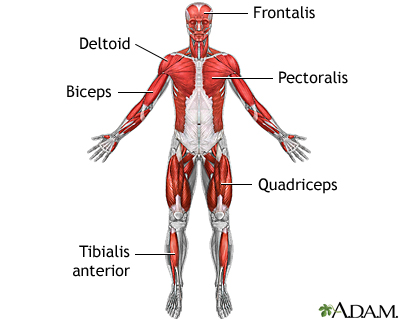
The Muscular System

The Muscular System is the system of muscles that are connected to your bone with tendon and other tissue. They convert force and chemical energy into tension and contraction, which allows your body to move. Muscles move by simply shrinking, but they can't expand. Muscles are made up of many tiny protein filaments. Many muscles are separated by nerves that connect the muscle to the brain. You have on Average about 600 muscles.
Muscles are necessary at all times. You have cardiac muscles in your heart which pump blood, and smooth muscles that line your inner organs. These muscles are called involuntary muscles because you can't control them consciously.
On the other hand, skeletal muscles can be control ed. I am typing using my skeletal muscles in my fingers, which I am controlling. Muscles make up about 23% of a women's weight, and about 40% of a man's weight. I think muscles can be used too much sometimes. Lats year I was pitching and i through my arm out. Now it hurts every time I use it a lot.

Click the link for more info: http://www.innerbody.com/image/musfov.html#

Cardiovascular System

The cardiovascular system is what allows your body to circulate blood, fight germs, and get rid of dead cells. The cardiovascular system is also known as the circulatory system which allows blood to flow through your body. In the circulatory system there are three different types of cells that each serve a different purpose. Red blood cells carry oxygen through the body, white blood cells fight of unknown bacterias, and clotting platelets that fill in scrapes, cuts, and other damaged parts of the body. All of these cells travel through the body with the help of three main organs. The Arteries pump blood away from the heart, veins bring the blood back to the heart,and capilaries which is where the arteries and veins connect to give out oxygen. If you stretch out your arteries, veins, and capillaries they could go around the world a little more than two full times. I personally thought that this article was interesting but also imformative. Here is a link to my source.

http://encarta.msn.com/encyclopedia_761566878/Circulatory_System.html

http://www.bioing.auckland.ac.nz/physiome/ontologies/cardiovascular_system.php

Saturday, May 17, 2008

The Nervous System

I have three sites for you to check out.  
The first one is basics about the nervous system, such as what nerves are.  I found the part about the how the nerve cells send messages the most interesting.
 

The second site is a more in depth versions of the brain parts and their jobs.  I thought, that how some scientist think that the left and right parts of the cerebrum are a lot different than they look, was really cool to think about. Also try "".


The third and the one that I think is the coolest is an interactive picture of the brain that lets you rotate it and look at all the different parts. 

go to site # 2 and click on the picture that looks like this:

"


Thursday, May 15, 2008

Anatomy Sites

Here are some sites you can use to research your organ systems:

If you're interested in cells, try CELLS Alive! at: http://www.cellsalive.com/


If you're brave, you can check out this NY Times slideshow: http://www.nytimes.com/slideshow/2008/04/21/science/Bassett_index.html

More images from the Bassett Collection are on Flickr at: http://www.flickr.com/photos/stanfordmedicine/sets/72157603949930348/

Wednesday, May 14, 2008

Earthquake in China - May 2008


Here is a slideshow showing some of the results of last week's earthquake in China:

There are more audio reports from NPR reporters on the scene here:


The "Chengdu Diary" starts off as a report on the culture of the Sichuan region of China, but then earthquake happened, and the reporters started covering that. It shows how a geological event can affect society at all levels.

FOR SCIENTIFIC DATA: The US Geological Survey has released a summary (and lots of other reports, maps, and links) here:

Wednesday, April 30, 2008

Chandra Data Reveal Rapidly Whirling Black Holes

If the supernova explosion is caused by material being pulled off a companion star onto the white dwarf, fusion of this material on the surface of the star should heat the star and produce a strong source.

http://www.nasa.gov/mission_pages/chandra/news/08-003.html

Journey to Saturn


Here is a NASA program that lets you see Saturn as Cassini sees it:


Sunday, April 20, 2008

Cool Saturn Facts

Here are some cool Saturn facts:
The wind on Saturn at the core can reach 500 meters per second, or 1100 miles per hour.
The probe Cassini that orbits the A and B ring sectors is named after Giovanni Cassini who discovered these sectors in 1675.
more cool facts coming soon.
Here's a cool website about Saturn. (click on "Saturn")

Tuesday, March 25, 2008

Solar System Resources

Here are some AWESOME sources of information about our Solar System:

While learning about the planets, you might find it useful to have a periodic table handy:

A Good Shot from Saturn

So, do you think you're a good shot at pool? Maybe you should try a long shot like this:
Yes, Cassini's done it again! This is a shot of Earth, viewed THROUGH the rings of Saturn, FROM the shadow of Saturn! (That means the sun is in this picture, but it's hidden behind Saturn.)
I know it seems kind of funny to think of this as a long-range, complicated pool shot, but remember that Cassini didn't just HAPPEN to be in this position. Some very skilled scientists from NASA managed to put it out there.

Saturday, March 22, 2008

"World Water Crisis" Photo Gallery

I've just discovered time.com's photogalleries, including such interesting slideshows as World Water Crisis...

These are beautiful photos, and each one has some good scientific and social information in the caption. Which is your favorite? Well, maybe I shouldn't ask about your "favorite" photo, since many of them are rather scary or disgusting. Which photo do you think is the most memorable? What does the caption tell you about it? (Include a link to the photo, if you can.)

Thursday, March 20, 2008

Evidence of Another Universe Found

This article is about how scienceits found another unvierse. The universe is about six billion trillion miles across. To find out more go to this link. http://www.itwire.com/content/view/15488/1066/1/1/

mind game

did you ever think about mind control. well you can control this mind controlled videow game
heres a link
http://news.bbc.co.uk/1/hi/health/5167938.stm
sorrey i cant link