Science and technology news from Hopkinton Independent School

Sunday, May 18, 2008

The Muscular System

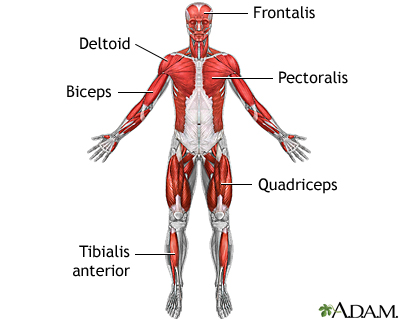
The Muscular System is the system of muscles that are connected to your bone with tendon and other tissue. They convert force and chemical energy into tension and contraction, which allows your body to move. Muscles move by simply shrinking, but they can't expand. Muscles are made up of many tiny protein filaments. Many muscles are separated by nerves that connect the muscle to the brain. You have on Average about 600 muscles.
Muscles are necessary at all times. You have cardiac muscles in your heart which pump blood, and smooth muscles that line your inner organs. These muscles are called involuntary muscles because you can't control them consciously.
On the other hand, skeletal muscles can be control ed. I am typing using my skeletal muscles in my fingers, which I am controlling. Muscles make up about 23% of a women's weight, and about 40% of a man's weight. I think muscles can be used too much sometimes. Lats year I was pitching and i through my arm out. Now it hurts every time I use it a lot.

Click the link for more info: http://www.innerbody.com/image/musfov.html#
Cardiovascular System

The cardiovascular system is what allows your body to circulate blood, fight germs, and get rid of dead cells. The cardiovascular system is also known as the circulatory system which allows blood to flow through your body. In the circulatory system there are three different types of cells that each serve a different purpose. Red blood cells carry oxygen through the body, white blood cells fight of unknown bacterias, and clotting platelets that fill in scrapes, cuts, and other damaged parts of the body. All of these cells travel through the body with the help of three main organs. The Arteries pump blood away from the heart, veins bring the blood back to the heart,and capilaries which is where the arteries and veins connect to give out oxygen. If you stretch out your arteries, veins, and capillaries they could go around the world a little more than two full times. I personally thought that this article was interesting but also imformative. Here is a link to my source.

http://encarta.msn.com/encyclopedia_761566878/Circulatory_System.html

http://www.bioing.auckland.ac.nz/physiome/ontologies/cardiovascular_system.php

Saturday, May 17, 2008

The Nervous System

I have three sites for you to check out.  
The first one is basics about the nervous system, such as what nerves are.  I found the part about the how the nerve cells send messages the most interesting.
 

The second site is a more in depth versions of the brain parts and their jobs.  I thought, that how some scientist think that the left and right parts of the cerebrum are a lot different than they look, was really cool to think about. Also try "".


The third and the one that I think is the coolest is an interactive picture of the brain that lets you rotate it and look at all the different parts. 

go to site # 2 and click on the picture that looks like this:

"


Thursday, May 15, 2008

Anatomy Sites

Here are some sites you can use to research your organ systems:

If you're interested in cells, try CELLS Alive! at: http://www.cellsalive.com/


If you're brave, you can check out this NY Times slideshow: http://www.nytimes.com/slideshow/2008/04/21/science/Bassett_index.html

More images from the Bassett Collection are on Flickr at: http://www.flickr.com/photos/stanfordmedicine/sets/72157603949930348/

Wednesday, May 14, 2008

Earthquake in China - May 2008


Here is a slideshow showing some of the results of last week's earthquake in China:

There are more audio reports from NPR reporters on the scene here:


The "Chengdu Diary" starts off as a report on the culture of the Sichuan region of China, but then earthquake happened, and the reporters started covering that. It shows how a geological event can affect society at all levels.

FOR SCIENTIFIC DATA: The US Geological Survey has released a summary (and lots of other reports, maps, and links) here:

Wednesday, April 30, 2008

Chandra Data Reveal Rapidly Whirling Black Holes

If the supernova explosion is caused by material being pulled off a companion star onto the white dwarf, fusion of this material on the surface of the star should heat the star and produce a strong source.

http://www.nasa.gov/mission_pages/chandra/news/08-003.html

Journey to Saturn


Here is a NASA program that lets you see Saturn as Cassini sees it: